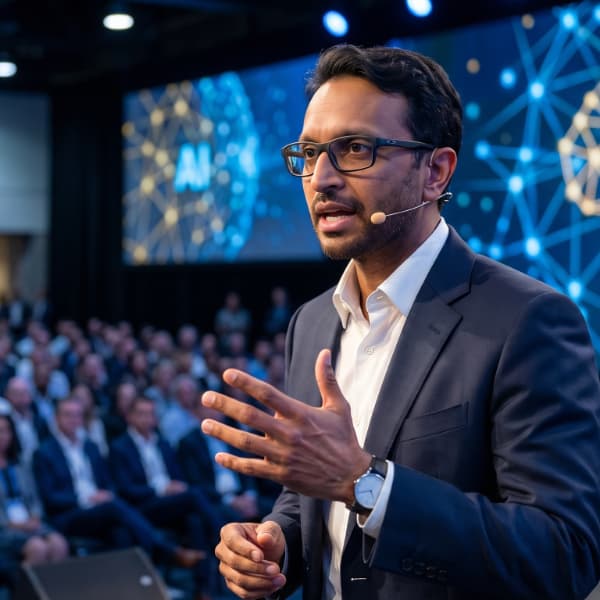
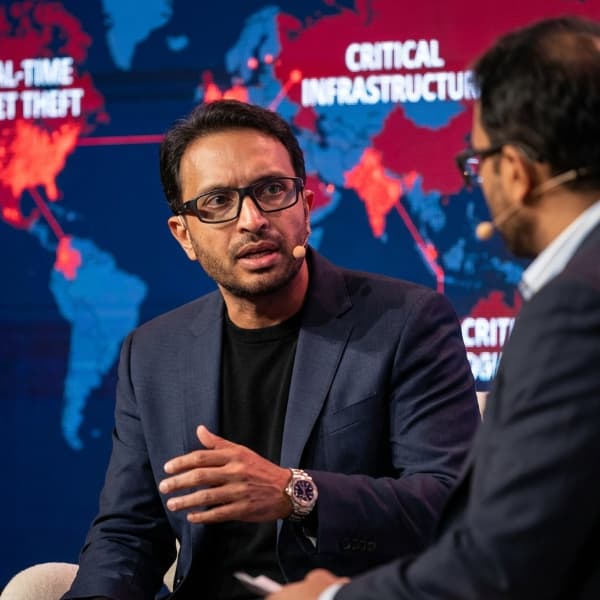
"Eight months ago, I had a conviction. Today, I have a movement — ten platforms, 240,000 followers, a global team, and sixty of the world's top investors watching every move we make"
I want to tell you what happened between those two sentences. Because somewhere inside this story is the reason you are reading it.
Before Mindvalley. I was a founder with a burning conviction and no vocabulary for it. I knew — as a father, as a builder, as a human watching the world lose its ability to concentrate — that attention was the most eroded human capability of our time. I knew someone had to build the category that trains it, the way emotional intelligence became a category a generation ago. I even had a name for it: Attention Intelligence™. But conviction without velocity is just a weight you carry. We had a product. We had a team. We had a brand. And we had the quiet, sinking feeling every honest founder knows — that we were building a company when the world needed us to build something bigger.
Then I walked into Mindvalley. And four voices, in four different sessions, reached in and rewired something.
Vishen said: "Build bigger than yourself. Build a movement, not a product." The next morning, I stopped describing MindSpring as a cognitive app. I started describing it as a movement — that attention is the new literacy, and that it can be trained. The language changed. The team aligned. Customers felt it in their chest before they felt it in their wallet.
Naveen Jain said: Stop hedging. Tell the truth about what you're actually building. So I stopped calling MindSpring a wellness brand and started calling it what it is — a public health initiative. We launched the National Children's Attention Index, tracking attention as a public health indicator across 280,000+ children globally, in partnership conversations with Johns Hopkins Bloomberg School of Public Health, with an ambition to publish in The Lancet. Nobody was doing this. After Naveen, I stopped waiting for permission.
Daniel Priestley said: Don't sell your product. Sell a free assessment. We built one for parents. One for knowledge workers. One for adults over 55. Each assessment became a doorway. Today, those assessments are the highest-converting acquisition channel across every market we operate in.
Kwame Christian said: Negotiation is a conversation, not a contest. I walked into the next investor room a different person. And the rooms multiplied. After Mindvalley.
We have now had approximately 60 investor conversations — including Sequoia, Bessemer Venture Partners, Khosla Ventures, Lux Capital, the Hinduja Family Office, and several of the world's leading impact funds — who track our progress every single month through our newsletter. One leading impact fund in California is currently issuing a term sheet for a multi-million-dollar investment in just one of our platforms. In the months since, we have:
Launched 10 platforms under the MindSpring umbrella, all powered by our proprietary FINE™ Framework (Focus Intelligent Neuro Engine) — AttentionHero for children, ZoneIn for knowledge workers, StaySharp Daily for adults 55+, and more.
Crossed 240,000+ followers across Instagram, YouTube, LinkedIn, and Facebook, with individual posts pulling in multi-million views.
Embedded more than 50 AI tools and AI agents across the business — compressing what used to be year-long build cycles into days.
Launched across six global markets — Australia, India, the Middle East, the United Kingdom, the United States, and Germany.
Built a global team and advisory board drawn from Harvard, Oxford, Cambridge, Stanford, and MIT.
Built the category. Built the research. Built the credibility. Built the velocity.
Finalized my fifth book, The Stolen Years — the narrative that will put Attention Intelligence™ on the global map.
What used to take us a year, we now ship in a week. What used to feel like a product launch now feels like a movement rally. The velocity is not incremental. It is a different universe — and we have only been running at full speed for eight months.
Why Mindvalley, and why now. I say this as an alumnus of both Harvard Business School and Oxford University, with the deepest respect for what those institutions taught me. Harvard gave me the foundational principles of business — the strategy, the finance, the discipline of the case method. Oxford gave me those same foundations with a sharper lens on empathetic leadership and global impact. Both shaped who I am as a leader, and I will always be grateful. But Harvard and Oxford were built for a different century. They teach you how the world has worked.
Mindvalley teaches you how the world is working right now — from the startup angle, from the frontier of AI, from the lived experience of founders who are building category-defining companies in real time. The speakers are not tenured faculty. They are operators. The case studies are not twenty years old. They are this quarter. The frameworks are not theoretical. They are being stress-tested by the next generation of entrepreneurs in the room with you.
If Harvard and Oxford gave me the foundation, Mindvalley gave me the velocity. And in this era, velocity is what separates the founders who build movements from the founders who build companies.
The real prize is not the numbers. It is the billion lives we now believe we can touch — the children whose futures bend the moment their attention is trained, the knowledge workers whose careers unlock when they can focus again, the aging adults whose final decades can be lived in full cognitive sharpness.
If you are reading this and wondering whether Mindvalley is worth it, I will tell you what I tell every founder who asks me:
Walk in with a conviction. Walk out with a movement.
It is exactly what happened to us — in eight months.
George Molakal Founder & CEO, MindSpring Innovations CEO, GoGenesis AI | Co-Founder, Acell88 Harvard Business School | Oxford University
George Molakal
CEO
Chicago, United States
Related Stories
“I completely restructured my business, and this month alone our sales have increased by 300% while we reduced ad spend by 50%”
Nora Cavani
Founder & CEO, Awarded Female Founder of the Year 2024 at WebSummit (Europe) · Stockholm, Sweden, Sweden

“I created AI employees and built a roadmap to scale my business”
Kimberly Braun
Public Speaking Professor · Boulder, Colorado, United States, United States
"The Win: I successfully streamlined my primary business workflow. By applying the frameworks taught here"
Dr.Madhu Nagesh
Founder · Bangalore, India, India
"I’ve built an entirely new website, funnel and I’ve created my 12 week coaching program"
Margaux Harari
Nutritionist · New York, United States, United States
"I saved over $10-15K almost immediately. The program paid for itself multiple times over on that alone"
Charu Aggarwal
Founder · New York, United States, United States

“I moved from theory into practical action with speed and scale”
Michael Pearman
Founder · Hamilton, Bermuda